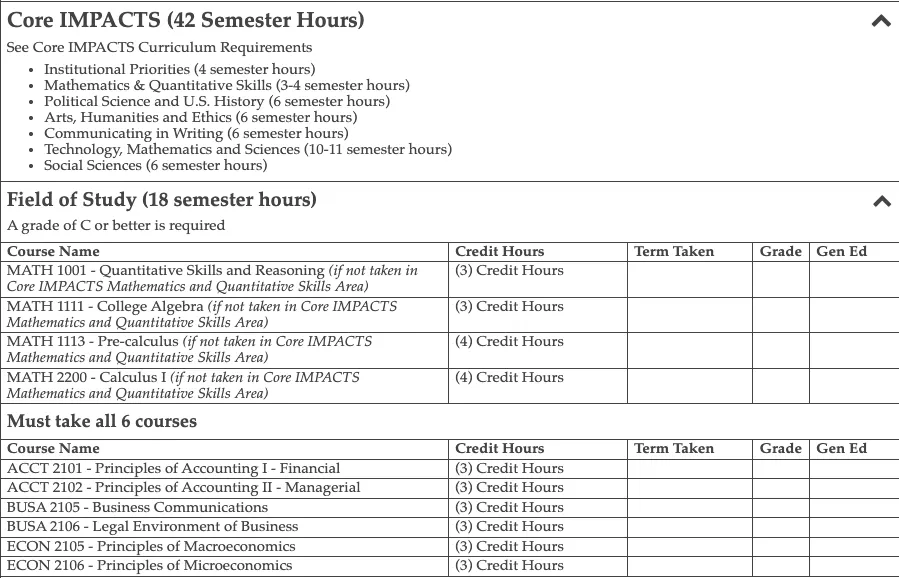
Program Plans assist in tracking academic progress for degrees and concentrations. They are divided by area and not necessarily in sequential order. There is a Program Plan for all majors.


<< An example of a portion of the program plan for the Business major, management concentration.


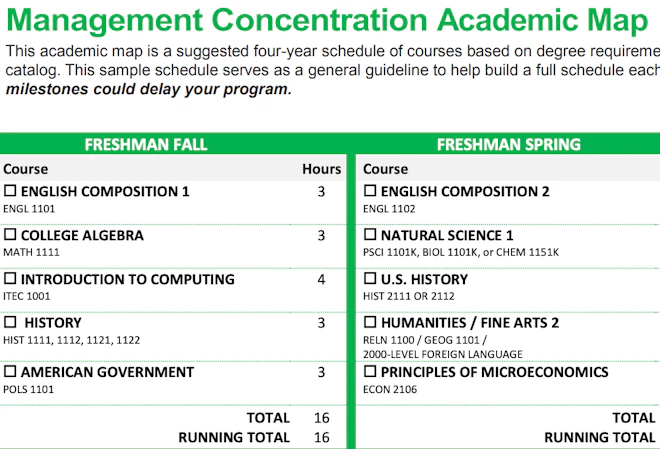
Academic Maps suggest a four-year schedule of courses based on degree requirements in the GGC Catalog and serve as a general guideline to help build a full schedule each semester. They give students a suggested sequence of courses that would allow the student to graduate in four years. 


An example of the academic map for the freshman year of the Business major, management concentration >>

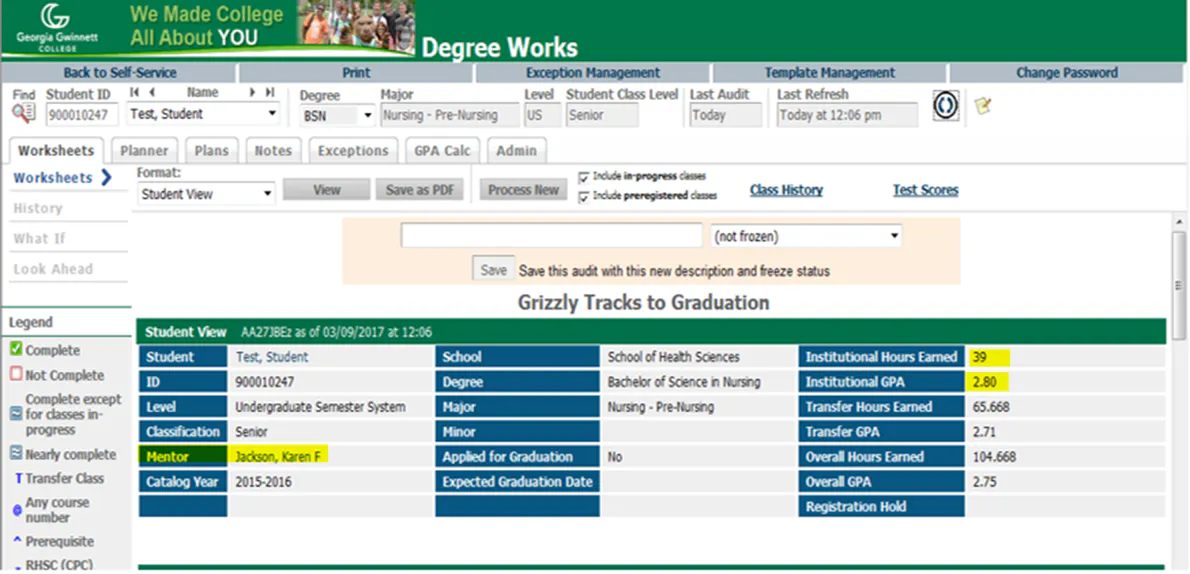
^^ Degree Works displays:

  1. Required courses for your selected focus area or major
  2. Classes registered for/or in progress
  3. Completed courses and earned credit hours (transfer credits, AP and CLEP credit)
  4. GPA
  5. Your assigned mentor's name (which be assigned to you during your first semester)

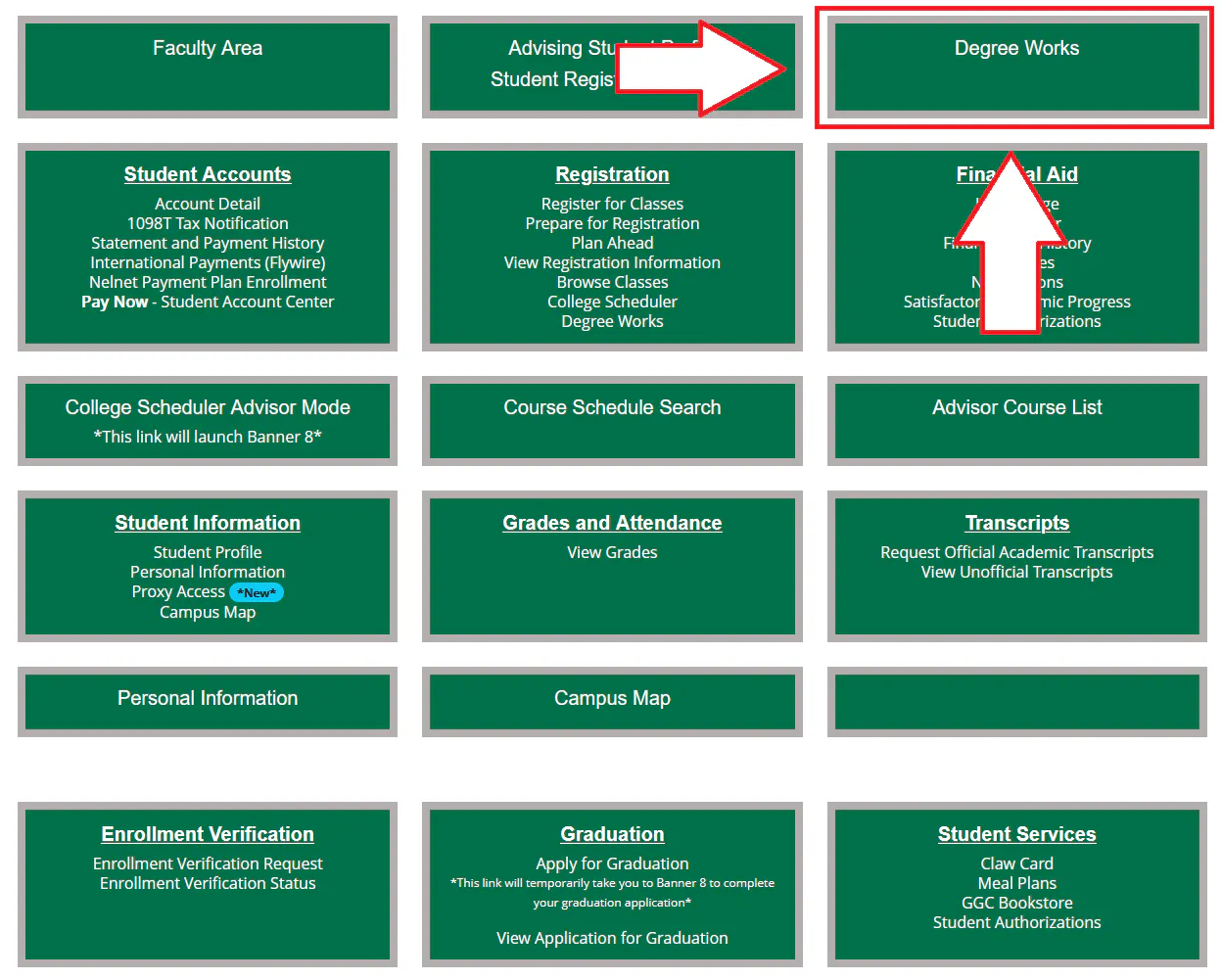
^^ Here are the steps to access your Degree Works:

  1. Visit https://www.ggc.edu/academics/registrar/grizzly-den-within-banner 
  2. Select Grizzly Den: Student Self-Service and log in with your GGC credentials
  3. Select Degree Works from the menu

Once you have accessed your Degree Works, you will be able to click on a course to read a brief description of the courses and the prerequisite(s) required for the course.

  • Class Load: The total number of credit hours you take in a semester. Full-time students typically take 12–17 credit hours.
  • Co-requisite: A course that must be taken at the same time as another course.
  • DegreeWorks: A planning tool in Banner that tracks your degree progress and helps you plan future classes.
  • Drop/Add: The period at the beginning of the semester when you can add or drop classes without academic penalty. Changes may affect your tuition and financial aid.
  • Hold: A restriction on your account that may prevent you from registering for classes until you complete a required task, such as orientation or advising.
  • Mentor (Academic Advisor): A faculty or professional advisor who helps you choose classes, plan your degree, explore majors, and prepare for your career.
  • Prerequisite: A course that must be completed before you can enroll in another course.
  • Withdrawal: The process of dropping a course after the Drop/Add period has ended. Withdrawals may affect your academic progress and financial aid.


View of list of more GGC Terms and Acronyms

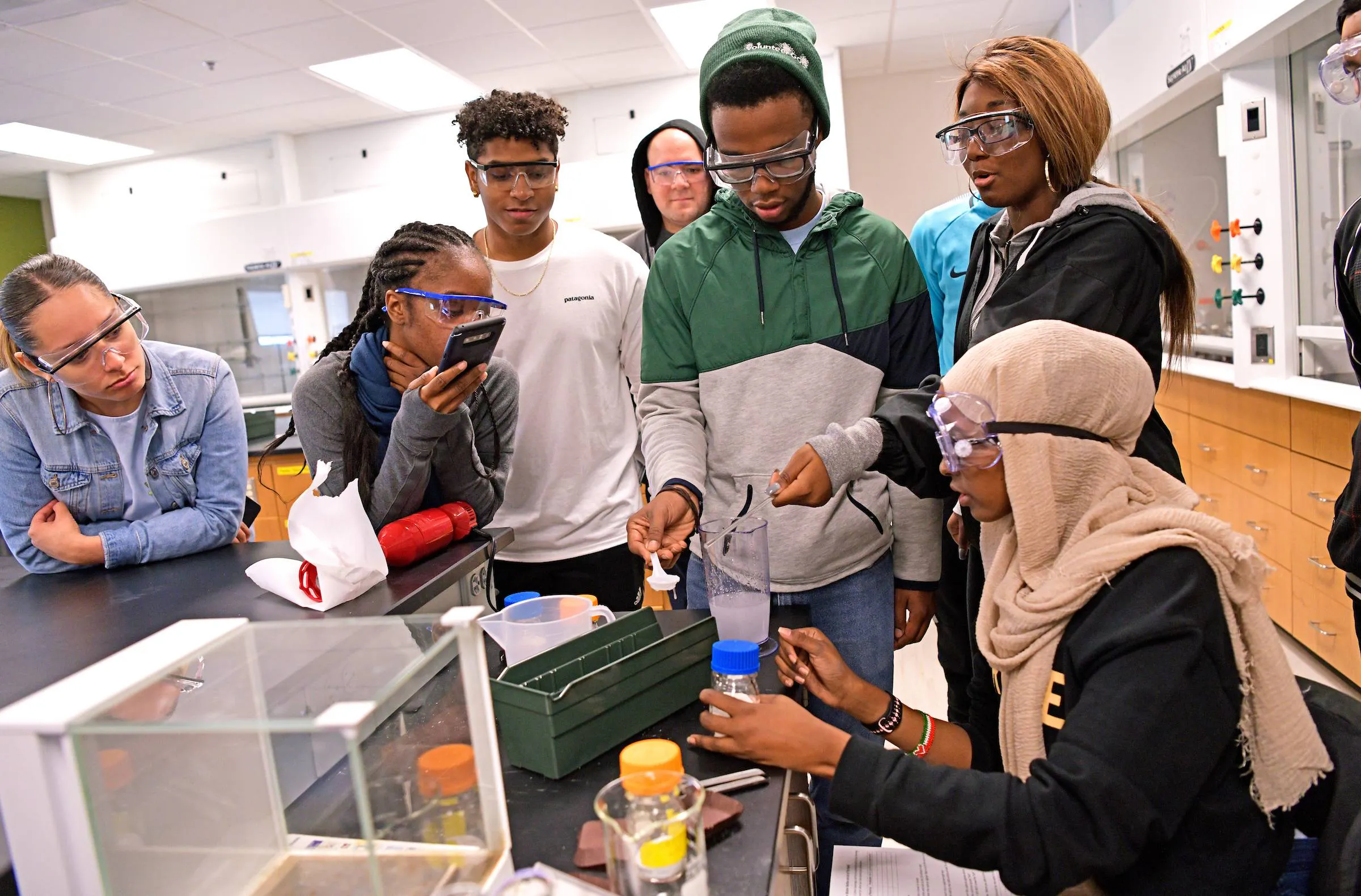
students working in a science lab

Learning communities are great options for you to make new and supportive friends while learning things that matter to you. Find your First-Year Learning Community, and select from a set of courses that are connected by a common academic focus area.


Key points for choosing a learning community:

  1. Make friends quickly and develop deeper friendships through participation in small communities.
  2. Benefit from a stronger network of support that always includes professors who want you to succeed. 
  3. Build a solid foundation that transforms your college experience and enhances your academic development and growth.
  4. Satisfy two to four core courses that fulfill degree requirements.

Check Your GGC Email Daily

You  are expected and REQUIRED to check your GGC email regularly. This is the main channel of communication for information from the institution and your professors. Due to privacy and policies at GGC, professional members of the GGC community will only be communicating to you using your GGC email account. 


Access Desire2Learn (D2L)

Before classes begin, be sure to log into your D2L (Desire2Learn) account. You can find important course information, such as class syllabi, assignments, and quizzes, within your D2L account. You can access your D2L account AFTER you register for courses.


Purchase Your Books/Materials

Materials required for each of your classes can be viewed on GGC Bookstore website. You can enter your class schedule under the "Textbooks" tab to find materials specific to your courses.


Through the GGC Bookstore you can purchase or rent textbooks and e-textbooks. It is also your one stop shop for all GGC school spirit and clothing items, textbooks, supplies, and technology items. 

Did you know that the GGC Bookstore will price match textbooks through Amazon and bn.com?

Clubs and Intramural Sports
Counseling and Psychological Services (CAPS)
Disability Services
Grizzlies Helping Grizzlies
Student Housing
Grizzly Care Team
Student Integrity
Student Life
Wellness & Recreation Center

Learn more about Student Affairs or email studentaffairs@ggc.edu with any questions or concerns. 


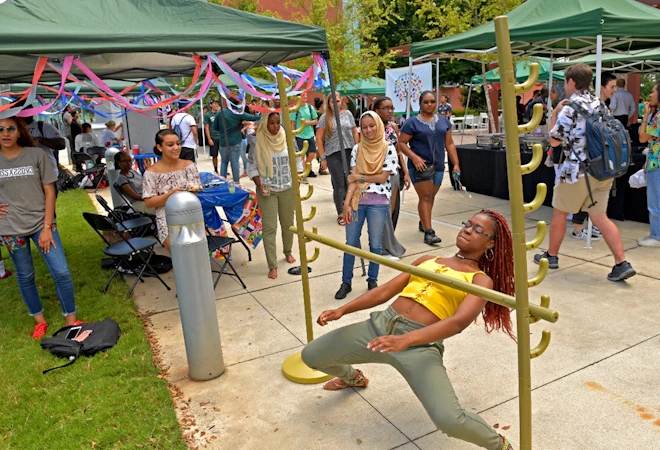
Student Life offers a variety of opportunities and experiences for you to enhance your Grizzly experience. You can join a student organization, participate in diversity or leadership training, attend a campus program or event, and so much more!

Why should you get involved?
  1. Leadership development
  2. Intellectual growth
  3. Self-knowledge
  4. Interpersonal skills
  5. Multicultural competency
  6. Enhance awareness of social and global issues
  7. Giving back to the community

How can you get involved as a Grizzly:

  1. Joining one of the 90+ student organizations 
  2. Participate in Fraternity or Sorority Life
  3. Volunteer with other Grizzlies on and off campus
  4. Show some spirit at Homecoming Events and Grizzly-Palooza
  5. Cultivate your leadership skills at Grizzly LEAD conference
  6. Participate in Student Government Association
  7. And so much more!

What are the Student Life services?

  1. Faculty Collaborative Programming
  2. Marketing & Graphic Design Services
  3. Marketing Guide
  4. Lounge and Study Space
  5. Multicultural Student Services Support
  6. Student Organization Resources & Storage


What are the main areas of misconduct?

  1. Academic dishonesty (or other acts of dishonesty)
  2. Disorderly Conduct
  3. Alcohol or other drug related misconduct
  4. Sexual assault and misconduct
  5. Theft, damage, and disregard for property
  6. Fire safety and sanitation
  7. Weapons
  8. Unauthorized entry/use of college property
  9. Violations of Student Housing and Residential Education (SHaRE)
  10. Misuse, abuse, or theft of computer time or services
  11. Gambling
  12. Hazing
  13. Interference with the student integrity process
  14. Violation of any other college policy
  15. Violation of law
  16. Being associated with or knowing about any of the above

Review and read more about Student Integrity, Code of Conduct, and Honor Statement in the Student Handbook